
Tank Sizing: Shallow Lagoon & Frag Tanks Guide for Aquarium Keepers
Size, light, and stabilize shallow lagoon and coral frag tanks—comparing 50-gallon Low Boys to 90F river tanks with PAR, evaporation, and flow math.
Updated 2026-11-20 · 1621 words
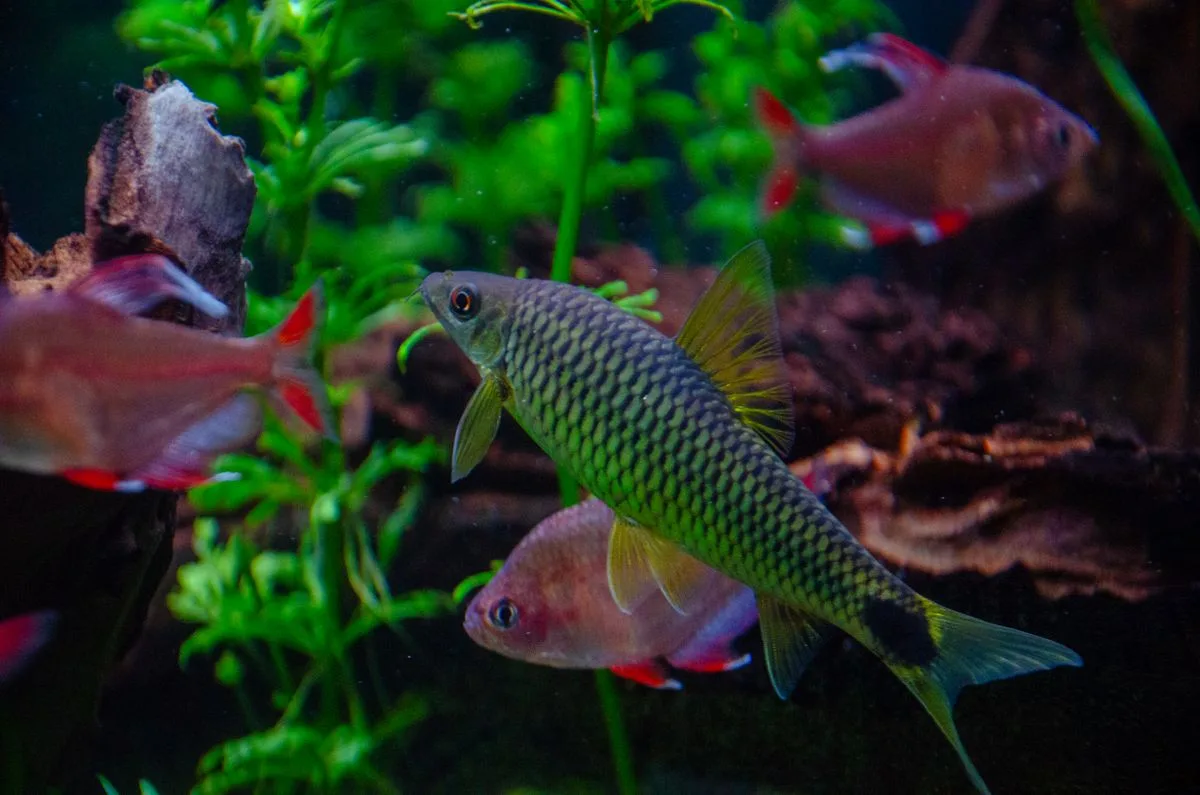
Ask experienced planted-tank aquascapers and coral propagators what tank shape they wish they had bought sooner, and "shallow and wide" tops the list almost every time. Shallow lagoon and frag tanks—ranging from 8 to 14 inches (20 to 35 cm) tall on generous 24-to-48-inch footprints—flip traditional aquarium math on its head. You get dramatic top-down viewing, effortless arm-dry maintenance, blazing bottom PAR from modest lights, and rock-solid oxygenation without needing giant, expensive glass thicknesses.
Yet shallow geometry introduces its own engineering traps: faster evaporative concentration, aggressive surface-wave sloshing if flow is misaimed, and tiny vertical margins for tall driftwood or branching SPS colonies. Here is how to size, light, plumb, and stabilize a shallow freshwater lagoon or marine frag tank in both US and metric measurements.
Why Shallow Geometry Changes Everything
Hydrostatic water pressure against an aquarium wall depends exclusively on water height, not total gallonage. A 48 × 24 × 10 inch (122 × 61 × 25 cm) 50-gallon frag tank exerts less than half the outward bending force on its glass panes compared to a standard 48 × 18 × 21 inch 75-gallon tank. That means shallow tanks can be built rimless with thinner, lighter, clearer glass (6 mm to 10 mm) at a fraction of the cost of tall rimless builds.
At the same time, flattening the water column transforms three daily operating variables:
- Surface-area-to-volume ratio doubles: A 50-gallon Low Boy frag tank (48 × 24 × 10 in) has 1,152 in² (7,432 cm²) of air-water interface—33% more surface area than a 75-gallon display despite holding 33% less water. Gas exchange and O2/CO2 equilibration happen rapidly, making fish hypoxia rare, though injected CO2 also off-gasses faster unless surface ripple is gentle.
- Evaporation hits salinity and TDS harder: Higher surface area paired with lower total volume means a dry winter room can evaporate 3% to 5% of total tank water per day—roughly twice the daily percentage swing of a 24-inch-tall tank.
- PAR attenuation virtually disappears: Water absorbs and scatters light exponentially with depth. In a 10-inch (25 cm) shallow tank, an LED fixture delivering 200 µmol/m²/s at the surface still delivers 145–160 µmol/m²/s at the bottom—allowing mid-wattage lights to grow high-light Acropora frags or dense Eleocharis carpets effortlessly.
Worked Example 1 (US): 50-Gallon "Low Boy" Marine Frag Tank
Let us run the complete math on the iconic US Zoo Med 50-Gallon Low Boy frag tank: 48 in × 24 in × 10 in external dimensions, 1/4-inch (0.25 in) glass, set up bare-bottom with PVC/acrylic frag racks and a 20-gallon sump at 78 °F and 1.026 SG.
- Internal Envelope: Subtract 0.50 in from length and width → 47.5 in × 23.5 in. Subtract 0.25 in bottom glass and a 1.0 in overflow/rim air gap → 8.75 in actual water depth.
- Pre-Rack Display Volume: (47.5 × 23.5 × 8.75) ÷ 231 = 42.28 US gal.
- Frag Rack & Plug Displacement: Egg-crate racks and 150 ceramic frag plugs occupy roughly 1.5 gal, leaving 40.8 US gal in the display. Add 14.2 gal operating volume in the 20-gallon sump for a total system volume of 55.0 US gallons.
- Evaporation & ATO Sizing: Over 1,152 in² of open water in a 45% RH room with two cooling fans or strong reef surface agitation, daily evaporation averages 1.2 to 1.6 gallons/day. Without a sump and ATO, losing 1.5 gal out of 40.8 gal swings salinity from 35.0 ppt to 36.3 ppt in 24 hours. Routing evaporation into a 20-gallon sump keeps display water level locked while an optical ATO feeds RO/DI water.
- Total Operating Weight: Empty 50G tank (48 lb) + display saltwater ($40.8 imes 8.55 = 349 ext{ lb}$) + sump & water (145 lb) + racks/pumps/skimmer/lights (45 lb) + 2×4 lumber stand (75 lb) = 662 lb spread across an 8.0 ft² footprint—an ultra-safe 82.8 lb/ft².
Worked Example 2 (UK/EU): 90F Shallow River & Mangrove Lagoon
Now let us run a metric freshwater/brackish example: an ADA-style 90F rimless shallow tank measuring 90 × 45 × 24 cm built from 8 mm low-iron glass, scaped as a hillstream loach river or emerged paludarium-lagoon at 22 °C.
- Gross Volume: (90 × 45 × 24) ÷ 1,000 = 97.2 L.
- Internal Envelope: Subtract 1.6 cm (two 8 mm panes) → 88.4 × 43.4 cm. Subtract 0.8 cm bottom glass and a 2.0 cm rimless air gap → 21.2 cm water depth.
- Pre-Hardscape Volume: (88.4 × 43.4 × 21.2) ÷ 1,000 = 81.3 L.
- River Cobble & Sand Displacement: Add a 3.5 cm silica sand bed (88.4 × 43.4 × 3.5 ÷ 1,000 = 13.4 L gross; at 60% solid = 8.0 L) plus 18 kg of smooth river cobbles (density 2.65 kg/L → 6.8 L displaced). True net water volume = 66.5 L.
- Flow Turnover Without Sandblasting: Hillstream loaches love brisk directional current (15–20× turnover = 1,000–1,300 L/h). In a 21 cm tall column, a narrow-nozzle powerhead aimed downward kicks up sand instantly. Instead, place a wide-mouth gyre or lily-pipe outflow at one short end aimed horizontally 3 cm below the surface, creating a smooth laminar river sweep across the full 90 cm runout.
Shallow Lagoon & Frag Tank Comparison Table
| Tank Format | Dimensions (US / Metric) | Gross Volume | Typical Net Water | Glass Thickness | Best Use Case |
|---|---|---|---|---|---|
| ADA 60F (Metric) | 23.6 × 11.8 × 7.1 in / 60 × 30 × 18 cm | 8.6 gal / 32.4 L | 6.5 gal / 25 L | 5 mm | Desktop wabi-kusa, shrimp, emerged moss |
| UNS 90B / 90F (Metric) | 35.4 × 17.7 × 9.4 in / 90 × 45 × 24 cm | 25.7 gal / 97.2 L | 18 gal / 68 L | 8 mm | Hillstream river scape, bonsai driftwood |
| 30 Gal Frag (US) | 24 × 24 × 12 in / 61 × 61 × 30 cm | 30 gal / 114 L | 24 gal / 91 L | 8 mm – 10 mm | Compact square coral grow-out or clam tank |
| 50 Gal Low Boy (US) | 48 × 24 × 10 in / 122 × 61 × 25 cm | 50 gal / 189 L | 41 gal / 155 L | 6 mm – 8 mm | Commercial/hobby coral frag & plant farm |
| 80 Gal Deep Blue Frag | 48 × 24 × 16 in / 122 × 61 × 41 cm | 80 gal / 303 L | 65 gal / 246 L | 10 mm – 12 mm | Shallow reef lagoon with room for tangs/wrasses |
Shallow Tank Setup & Troubleshooting Checklist
- Raise your light fixture higher than normal: Because water depth is only 8–12 inches (20–30 cm), mounting LEDs 14–18 inches (35–45 cm) above the water blends color channels evenly and prevents scorching shallow corals or triggering green spot algae on slow-growing Anubias.
- Install mesh screen tops for jumpers: Shallow water puts fish within inches of the rim; wrasses, gobies, hatchetfish, and Siamese algae eaters will launch out at night without a 1/4-inch (6 mm) clear mesh lid.
- Watch wavemaker splash height: Keep gyres and powerheads at least 3 inches (7.5 cm) below the surface and avoid pulsing wave modes that slosh water over rimless edges.
- Protect against sudden temperature drops: Shallow tanks lose heat fast across their huge top surface; size heaters conservatively with a backup controller and keep stands away from exterior drafty doors.
- Choose short-statured livestock: Avoid deep-bodied angelfish, discus, or tall altum-type species in tanks under 14 inches (35 cm) deep; stick to bottom-oriented gobies, corydoras, loaches, rasboras, and nano reef fish.
Sump & Overflow Sizing for Shallow Frag Systems
Because a shallow frag tank has minimal vertical height, even a 0.5-inch (1.3 cm) rise in display water level during a pump surge—or a 1-inch siphon back-drain during a power outage—represents a huge percentage of the tank's volume. On a 48 × 24 × 10 inch (122 × 61 × 25 cm) Low Boy, every 1 inch (2.54 cm) of vertical water height equals 4.99 US gallons (18.9 L).
If your return pump stops and your lock-line return nozzles sit 1.5 inches below the operating waterline without siphon-break holes, 7.5 gallons (28.4 L) will drain straight down into your sump before the siphon breaks—easily overflowing a small 20-gallon sump that is already running 14 gallons full! Always drill a 3/16-inch (5 mm) anti-siphon hole just below the normal waterline on the underside of every return nozzle, keep your sump baffle height low enough to hold at least 10 gallons (38 L) of emergency reserve capacity, and test a full power-cut draindown with towels on the floor before adding livestock.
Aquascaping Verticality Without Breaking the Waterline
In a tank only 9 to 12 inches (23 to 30 cm) tall, traditional tall stem plants like Rotala rotundifolia or Vallisneria hit the surface in ten days and shade everything underneath. Shallow freshwater lagoons shine brightest when you lean into emersed-to-submersed transitions and compact foreground/midground species:
- Emerged driftwood islands: Let spiderwood or redmoor branches breach the waterline by 4–8 inches (10–20 cm), wrapping the humid splash zone in Hydrocotyle tripartita, Anubias nana 'Petite', and Java moss that thrives in high humidity.
- Compact midground rosettes: Use Cryptocoryne parva, Cryptocoryne wendtii 'Compact', Blyxa japonica, and Staurogyne repens rather than tall Amazon swords that fold awkwardly against the surface.
- Shallow marine coral placement: Mount high-light Acropora and Montipora frags on low 1-inch (2.5 cm) egg-crate racks, reserving shaded corners under overflow boxes for lower-PAR LPS like Euphyllia, Acanthastrea, and zoanthids.
Heating & Cooling Efficiency in Wide Footprints
Shallow tanks exchange heat with the surrounding room rapidly. In winter, a 50-gallon Low Boy in a 65 °F (18 °C) basement needs 200–250 W of dual-redundant heating—just as much as a deeper 75-gallon display—because its 8 ft² top surface radiates heat continuously. Conversely, in summer, aiming a single quiet clip-on cooling fan across that wide open water surface drops tank temperature by 3–5 °F (1.7–2.8 °C) within hours via evaporative cooling, making shallow lagoons remarkably easy to chill without an expensive compressor chiller.
Top-Down Photography & Surface Skimming in Shallow Displays
Part of the magic of a 10-inch-tall lagoon or frag tank is viewing corals and fish from above—an angle where overhead LED glare and surface biofilm ruin clarity fast. Adding a compact surface skimmer (or a notched weir teeth box feeding your canister/sump) pulls oily protein films off the top millimeter of water continuously, turning the surface into crystal-clear glass. For top-down reef or wabi-kusa photos, switch off return pumps for three minutes, use a black acrylic top-down viewing portal to block overhead fixture reflections, and shoot straight down at 90 degrees.
Bare-Bottom vs. Thin-Sand Tradeoffs in Frag Tanks
In coral propagation systems, running a completely bare-bottom glass or white HDPE starboard floor lets you crank flow up to 35–45× turnover without sandstorms and siphon settled detritus cleanly during weekly 15% water changes. By contrast, a freshwater shallow river scape benefits from a thin 0.75-inch (2 cm) layer of heavy 1–2 mm river gravel that stays put under brisk horizontal current while still anchoring carpeting roots and beneficial nitrifying biofilm.
Plumbing Noise & Microbubble Control on Shallow Reefs
Because a shallow frag tank sits closer to eye level on a 30-inch (76 cm) or 36-inch (91 cm) stand and runs high flow through minimal water depth, drain gurgle and return microbubbles show up quickly. Running a dual-pipe Herbie or triple-pipe Bean Animal overflow with a submerged gate-valve siphon eliminates drain slurping completely, while placing a 100-micron filter sock and a 2-inch (5 cm) bubble-trap baffle in the sump stops tiny air bubbles from clouding your top-down coral view.
Reference Sources
- Zoo Med 50-Gallon Low Boy Frag Tank Specifications
- Light Attenuation & PAR in Shallow vs. Deep Reef Columns
- ADA Cube Garden 60F & 90F Rimless Specifications