
Aquascaping: Seiryu Stone KH Hardening Guide for Aquarium Keepers
Understand why Seiryu stone raises KH, GH, and pH under CO2 injection, calculate weekly mineral drift in US and metric tanks, and balance Ca:Mg ratios with RO/DI water changes.
Updated 2026-11-20 · 1731 words
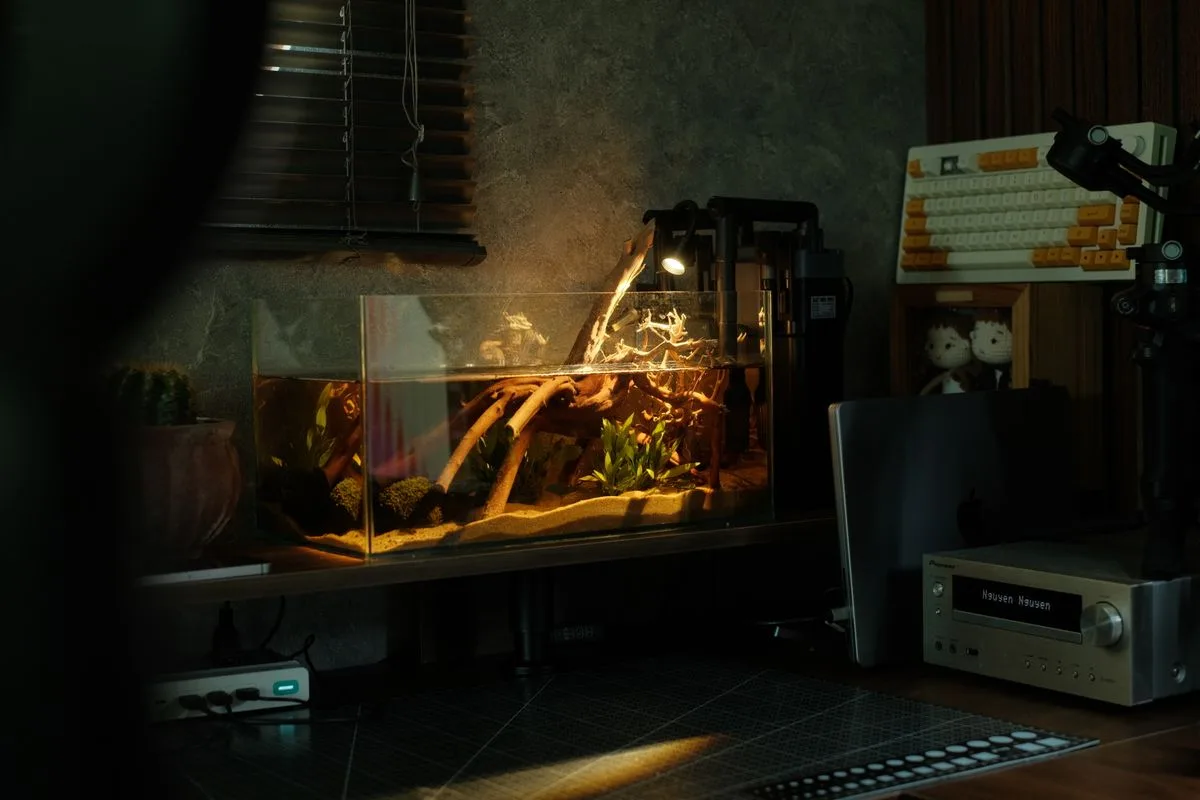
Seiryu stone is arguably the most beloved aquascaping rock on the planet—and the quietest source of mystery plant melt and shrimp deaths in beginner high-tech tanks. With its jagged slate-blue fractures and crisp white quartz-and-calcite veins, Seiryu turns any 60P or 40-Breeder into a miniature alpine peak. Yet within two weeks of flooding, keepers routinely watch their carbonate hardness (KH) climb from 2 dKH to 7 dKH, their pH bounce upward overnight, and sensitive Caridina shrimp or soft-water stem plants stall.
That shift is not a defect in your water test kit—it is pure carbonate geochemistry happening in real time inside your glass box. This guide explains why Seiryu stone hardens water, how injected CO2 accelerates dissolution, and exact US and UK/EU worked water-change and RO/DI math to keep a Seiryu scape thriving without chasing pH.
The Chemistry: Why Seiryu Stone Dissolves Faster With CO2
True Seiryu stone (and its closely related Ryuoh stone) is a metamorphosed limestone/marble matrix threaded with calcium carbonate ($CaCO_3$) veins. In neutral or alkaline water (pH 7.6+), calcium carbonate is nearly insoluble. The moment you inject pressurized CO2 for planted growth—or use an acidic active aquasoil like ADA Amazonia—dissolved carbon dioxide forms carbonic acid ($H_2CO_3$) and drops water pH into the 6.0–6.6 range:
CaCO3 (solid stone) + CO2 + H2O ⇌ Ca2+ + 2 HCO3−
Every molecule of calcium carbonate that dissolves releases one calcium ion (raising GH / general hardness) and two bicarbonate ions (raising KH / carbonate hardness and buffering pH upward). Crucially, this creates a tug-of-war in aquasoil tanks:
- Aquasoil works to absorb carbonate ions and hold pH down around 6.0–6.5.
- Seiryu stone continuously leaks calcium and bicarbonate back into the water, exhausting your aquasoil's buffering capacity months earlier than normal and driving GH/TDS upward between water changes.
Stone Hardness Comparison Table: Acid-Reactive vs. Inert Rocks
| Stone Name | Mineral Composition | KH / GH Impact | Acid / Vinegar Fizz Test | Best Livestock & Plant Pairing |
|---|---|---|---|---|
| Seiryu / Ryuoh Stone | Calcite-veined limestone/marble | Moderate–High (+1 to +4 dKH/wk) | Fizzes visibly on white veins | Neocaridina, rasboras, hardy carpets (Monte Carlo) |
| Ohko (Dragon Stone) | Hardened clay / sedimentary silt | Inert (0 dKH/dGH change) | No fizz | Caridina crystal shrimp, discus, soft-water stems |
| Manten Stone | Dense volcanic/mineralized slate | Negligible to very slight | No fizz | High-end Iwagumi, soft-water tetras |
| Volcanic Lava Rock | Basaltic scoria | Inert (0 dKH/dGH change) | No fizz | All planted tanks, biological base layers |
| Texas Holey Rock | Porous karst limestone | Extreme (+4 to +10 dKH/wk) | Vigorous fizz everywhere | African cichlids (Malawi/Tanganyika), livebearers |
| Granite / River Cobble | Quartz, feldspar, mica | Inert (0 dKH/dGH change) | No fizz | Hillstream loaches, Amazonian blackwater |
Worked Example 1 (US): Managing 45 lb of Seiryu in a 40-Gallon Breeder
Suppose you build a dramatic mountain Iwagumi in a US 40-Gallon Breeder (33 US gallons net water) using 45 lb of Seiryu stone, pressurized CO2 targeting a 1.0 pH drop, and city tap water that comes out at 4 dKH / 6 dGH.
- Expected Weekly Drift: At roughly 1.35 lb of Seiryu per net gallon under CO2 injection (pH ~6.6), expect hardness to climb by roughly +2.0 dKH and +2.0 dGH every 7 days (about +35 ppm TDS per week).
- The Tap-Water Compounding Trap: If you only do a 25% weekly water change with 4 dKH tap water, your tank's KH never resets—it ratchets steadily upward toward 8–10 dKH, pushing your CO2 target pH up and locking out trace iron uptake in sensitive stems.
- The 50% Reset + RO/DI Blend Fix: Switch to 50% weekly water changes using a 50/50 blend of tap water and RO/DI water (2 dKH / 3 dGH). Even if the stones push tank KH from 2.5 dKH up to 4.5 dKH by Sunday, a 50% change with 2 dKH blend water resets Monday morning right back to 3.25 dKH—holding your tank permanently in a stable 3.0–4.8 dKH band that hardy plants and Neocaridina shrimp love.
Worked Example 2 (UK/EU): 22 kg Seiryu in a 90P Soft-Water Tank
Now consider a European 90P rimless tank (150 L net water) with 22 kg of Seiryu stone (0.147 kg/L), active aquasoil, and pure remineralized RO water starting at 0.5 dKH / 5 dGH at 24 °C.
- Expected Drift: With fresh aquasoil pulling KH down and CO2 running at 30 mg/L (pH ~6.4), the 22 kg of Seiryu will add roughly +1.5 to +2.5 dGH and +1.5 dKH per week during the first 3–4 months before biofilms slightly coat the stone pores.
- Remineralization Adjustment: Do not remineralize your change water all the way to 6 dGH with calcium/magnesium salts if Seiryu is already leaching calcium! Instead, remineralize your 75 L (50%) weekly RO change water to 3.5 dGH / 0 dKH using a GH-only booster (plus a touch of Epsom salt / magnesium sulfate, since Seiryu leaches calcium without magnesium, which can skew your Ca:Mg ratio above 6:1 and cause twisted new leaf tips).
Can You Seal Seiryu Stone Permanently?
Many keepers ask if brushing clear matte polyurethane, aquarium-safe epoxy, or silicone spray onto Seiryu stone stops KH leaching. In practice, sealing Seiryu stone is rarely worth the effort: even microscopic pinholes in a brushed coat let acidic CO2 water seep underneath, flaking the sealer off within 6–12 months—and worse, glossy coatings turn natural slate-grey stone into shiny plastic-looking props underwater. If you want zero KH rise for delicate Caridina bee shrimp or Tonina stems, choose genuinely inert Manten stone, Frodo stone, or dark basalt instead.
Seiryu Stone Chemistry & Troubleshooting Checklist
- Test every batch with vinegar or muriatic acid: Drop white vinegar onto a hidden back facet—if it fizzes gently on the white veins, it is true calcite-bearing Seiryu and will raise KH/GH.
- Supplement magnesium alongside Seiryu: Seiryu releases Ca2+ only; dose a pinch of magnesium sulfate (MgSO4·7H2O) after water changes to maintain a healthy 3:1 to 4:1 Ca:Mg ratio for lush plant growth.
- Skip Seiryu for soft-water Caridina shrimp: Crystal Red and Taiwan Bee shrimp thrive at 0–1 dKH and stable pH 6.0–6.4; the daily KH swing from Seiryu stresses molting shrimp.
- Commit to 40–50% weekly water changes: Large, consistent weekly water changes are the simplest, cheapest way to prevent long-term mineral creep in any Seiryu aquascape.
- Track TDS with a \$15 digital pen: Checking total dissolved solids (ppm) takes five seconds before and after your weekly change and warns you immediately if evaporation or stone dissolution is creeping upward.
Acid-Test & Pre-Soak Protocol Before Hardscaping
Not every rock sold under the name "Seiryu" behaves identically. Some dark-grey batches from certain quarries are nearly pure basalt with faint quartz lines that barely budge KH by +0.3 dKH per week, while pale-blue heavily veined batches fizz like Alka-Seltzer in weak acid and jump KH by +4 dKH in four days. Before gluing a single stone into your display, run a simple 24-hour bucket test:
- Scrub and rinse: Wire-brush loose quarry dust off your chosen stones under running water.
- Submerge in a measured bucket: Place 10 lb (4.5 kg) of stone into 5 gallons (19 L) of RO/DI or distilled water—matching the stone-to-water ratio of your planned tank—and add a splash of carbonated seltzer water to simulate CO2-enriched pH (~6.2).
- Test KH and GH at 0 hours and 48 hours: If KH climbs by more than 2–3 dKH in 48 hours, you know upfront that your scape needs 50% weekly RO-blended water changes rather than 25% tap top-ups.
Why Aquasoil Exhausts Faster Around Limestone
Active cation-exchange aquasoils soften water by trading hydrogen ions ($H^+$) for calcium and magnesium ions while neutralizing bicarbonate alkalinity. When heavy Seiryu stone sits directly in active aquasoil, the soil around the stone's base burns through its acid-buffering reserve two to three times faster than normal. Keep Seiryu stone scapes looking crisp long-term by pairing them with resilient, moderate-hardness plants like Micranthemum 'Monte Carlo', Eleocharis parvula, Anubias, Microsorum (Java fern), and Rotala rotundifolia—all of which flourish at 3–6 dKH and pH 6.6–7.2 without needing ultra-soft blackwater chemistry.
Calculating Exact CO2 Drop-Checker & pH Targets With Seiryu Stone
Because Seiryu stone steadily adds carbonate alkalinity (KH) between water changes, relying solely on a pH-KH reference chart to judge dissolved CO2 can mislead you unless you re-test KH right before checking pH. For example, if your tap water starts at 3 dKH on Sunday (putting 30 ppm CO2 at pH 6.5), and Seiryu stone pushes your tank to 6 dKH by Friday, 30 ppm CO2 now corresponds to pH 6.8—not 6.5! If you crank up your needle valve chasing pH 6.5 at 6 dKH, you drive dissolved CO2 past 60 ppm and suffocate your fish. Always rely on a calibrated 4 dKH bromothymol blue drop checker (which stays isolated from tank KH changes) rather than raw tank pH alone when running pressurized CO2 over Seiryu stone.
When Does Seiryu Stone Slow Down?
Freshly quarried, acid-etched Seiryu stone leaches fastest during its first 60 to 90 days underwater because sharp micro-crystalline calcite edges expose maximum surface area. Over four to six months, harmless thin biofilms and trace mineral precipitation slightly passivate the stone surface, often cutting weekly KH rise by 30% to 40%. Still, as long as you inject CO2, dissolution never drops to zero—so build a sustainable 40–50% weekly water-change rhythm from day one rather than hoping the stones will "cure" completely.
Using Seiryu Stone Safely in Low-Tech (No-CO2) Tanks
Interestingly, Seiryu stone behaves far more gently in low-tech aquariums without pressurized CO2. At a natural atmospheric equilibrium pH of 7.2–7.6, calcium carbonate dissolution slows to a crawl—often adding just +0.3 to +0.6 dKH per week. For low-tech Neocaridina shrimp, guppies, or hardy Anubias and Java fern layouts, a small-to-moderate Seiryu cluster acts as a mild, helpful mineral buffer rather than a chemistry headache.
Replacing or Blending Seiryu Stone When Parameters Drift Too High
If you already flooded a tank packed with 50 lb (23 kg) of Seiryu stone and realize your tap water (already 8 dKH / 12 dGH) leaves zero headroom for carbonate creep, you do not always have to tear down the entire scape. Pulling just one or two bulky rear-corner support rocks—and replacing them with dark basalt or lava rock hidden behind stem plants—cuts exposed calcium carbonate surface area by 30–40% without changing the front viewing silhouette. Paired with an under-sink 4-stage RO/DI unit for 50/50 water-change dilution, even high-mineral municipal tap water can support a crisp, stable Seiryu layout.
Quick Conversion: Converting ppm Alkalinity to dKH
Many US municipal water reports and reef-style test kits report alkalinity in ppm CaCO3 rather than German degrees (dKH). Divide ppm by 17.85 to get dKH (so 71 ppm = 4.0 dKH), and divide GH ppm by 17.85 to get dGH—making it simple to track Seiryu stone's weekly mineral contribution regardless of which test kit sits in your cabinet.
Keep a dated water-log card taped inside your stand door recording pre-change and post-change KH, GH, and TDS for the first six weeks; once you see your exact weekly curve flatten out, maintenance becomes completely predictable.
Reference Sources
- Calcium Carbonate Dissolution Equilibria in CO2-Enriched Aquaria
- ADA Ryuoh & Manten Stone Mineral Characteristics
- Calcium-to-Magnesium Ratios in Planted Aquaria